| Developer | Sono Elements |
|---|---|
| Released | 9 August 2018 |
| Instrument type | Sample-based Mellotron emulation |
| Sounds | 7 |
| Formats | VST and AU instrument |
| Systems (original page) | Windows 7, 8, 10 and macOS |
| Launch price | US$19 |
| Status (checked 2 Nov 2026) | No longer sold; original store page gone |
Overview
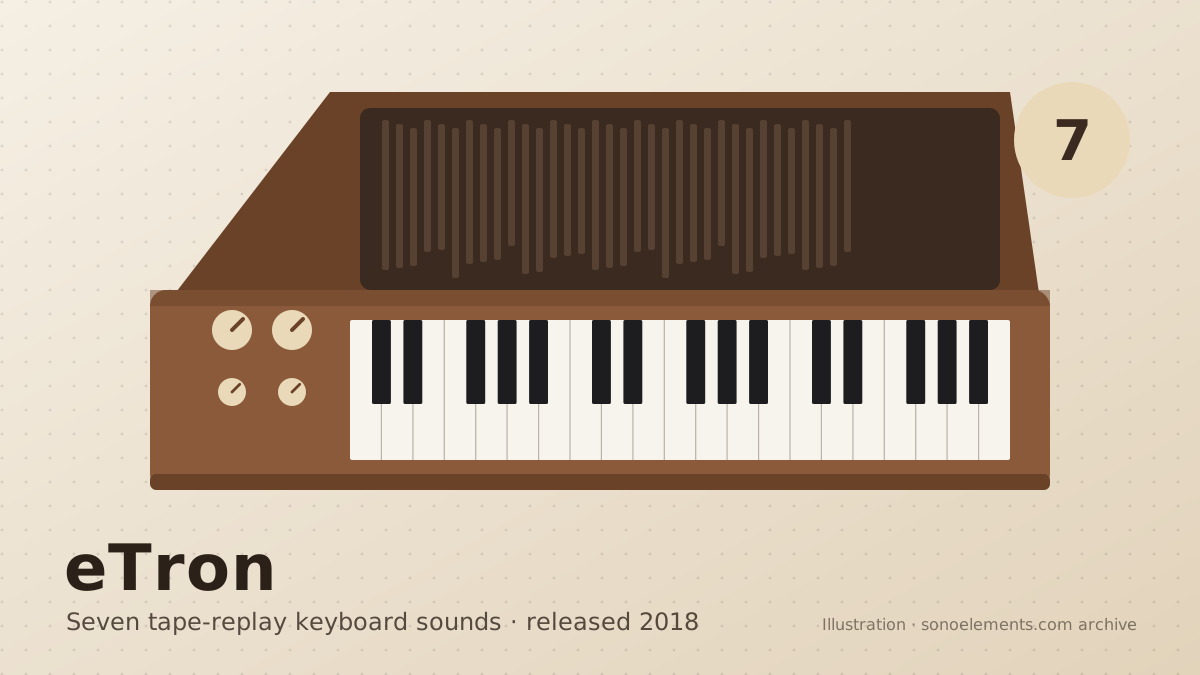
eTron was the first instrument Sono Elements released. It went live on this domain on 9 August 2018, the same day as its sister plugin Model Keys, and it set the pattern every later Sono Elements product followed: one recognisable vintage instrument, a handful of carefully chosen sounds and a single small window of controls.
The instrument it recreates is the Mellotron, the tape-replay keyboard developed in England in the early 1960s. Inside a Mellotron each key sits above its own strip of magnetic tape holding a recording of a real instrument playing that note. Pressing the key drags the tape past a playback head; releasing it lets a spring pull the tape back to the start. Each strip lasts about eight seconds, so long notes eventually run out, and the mechanism adds small wobbles in pitch and level from key to key. Those quirks are a large part of why the instrument still sounds the way it does on records such as the Beatles’ “Strawberry Fields Forever” or King Crimson’s 1969 debut.
The original eTron page placed the instrument in that history, naming acts from Tangerine Dream and Genesis to the 1990s albums by Oasis and Radiohead that brought the sound back. Rather than chase every tape set ever made, Sono Elements picked seven of the best-known sounds and kept the interface deliberately plain, which the developer summed up as “no fuss”.
A year later the developer followed it with eTron Pro, which expanded the library to seventeen sounds. The original eTron stayed on sale alongside it at the lower price.
Hear for yourself
eTron demo: “Funeral of Queen Mary” (A Clockwork Orange title music)
The developer’s page said no external effects were used, so the recording is meant to show eTron on its own.
The recording belongs to the developer and is hosted by SoundCloud. Nothing is loaded from soundcloud.com until you click; after that, SoundCloud may set its own cookies (see the privacy policy). Open it on SoundCloud.User Interface
eTron used one fixed-size window with every control visible at once. The schematic below is drawn from the descriptions in the developer’s user manual; it shows how the controls were grouped, not what the original graphics looked like.
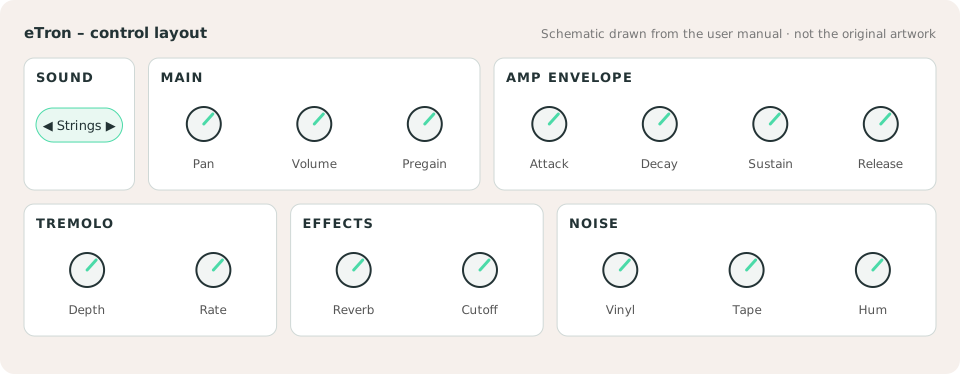
- Sound selector: left and right arrows step through the seven sounds.
- Main: pan and volume for the whole instrument. Pregain sets how hard the selected sound drives the output; turned fully up it adds deliberate distortion.
- Amp envelope: a standard attack, decay, sustain and release envelope.
- Tremolo: a stereo tremolo. The higher the depth, the further the sound swings between the left and right speakers.
- Effects: a simple room reverb and a low-pass filter for taming bright sounds.
- Noise: separate levels for vinyl crackle, tape hiss and electrical hum, to make the sound feel older and less clean.
Features
- Seven Mellotron sounds: strings, flute, brass, cello, woodwinds, male choir and female choir
- Amplitude ADSR envelope
- Stereo tremolo, room reverb and low-pass filter
- Adjustable vinyl crackle, tape hiss and electrical hum
- Main parameters controllable by MIDI CC (list in the FAQ)
- VST and AU instrument for Windows and macOS
Sounds
- Strings
- Flute
- Brass
- Cello
- Woodwinds
- Choir (men)
- Choir (women)
System requirements
- Windows 7 or 10, or macOS High Sierra or later (the product page also listed Windows 8)
- At least 200 MB of free disk space
- At least 1 GB of RAM
- A VST or AU host (DAW)
- Intel Core i5 at 1 GHz or better
Manual
Sono Elements eTron User Manual (PDF, about 210 KB)
The developer uploaded the manual to the Internet Archive on 10 August 2018, and it is still there. It covers requirements, installation, the interface, the sound list, MIDI CC numbers and the licence terms.
Purchase
At launch eTron cost US$19 and was sold through a Gumroad store page linked from the original article. That store page no longer exists: the link returned “not found” when this archive checked it on 2 November 2026. As far as this archive can tell, the plugin is no longer on sale anywhere.
This site does not sell eTron. It cannot issue licences, resend downloads, process refunds or look up past orders, because it is not run by the developer. See the FAQ for what we do and do not know.
By 2020 the product page also carried a short warning that eTron did not work on macOS Catalina (10.15) and that an update was on the way. The warning is missing from captures in December 2019 and present from September 2020. This archive has not been able to confirm whether that update was ever released, and it has no information about later macOS versions or Apple silicon Macs.
Sources
- Archived eTron page, 9 Nov 2020 (Wayback Machine)
- eTron user manual, uploaded by the developer (Internet Archive)
- KVR Audio: Sono Elements releases eTron and Model Keys (Aug 2018)
- Synthtopia: New Mellotron plugin for Mac & Windows, eTron (10 Aug 2018)
- MusicRadar: Sono Elements eTron review
Original page: Wayback Machine capture of 9 November 2020. Last legitimate capture of this URL. Release date source: Atom feed of the original blog (captured 3 Dec 2018). This page was written on 2 November 2026 in new words; facts were checked against the sources above.