| Developer | Sono Elements |
|---|---|
| Released | 18 August 2018 |
| Instrument type | Sample-based ARP Solina String Ensemble emulation |
| Sounds | 6 tones, mixable |
| Formats | VST and AU instrument |
| Systems (original page) | Windows 7, 8, 10 and macOS |
| Launch price | US$19 |
| Status (checked 2 Nov 2026) | No longer sold; original store page gone |
Overview
SolinStrings arrived nine days after the first two releases, on 18 August 2018. Its subject is the ARP Solina String Ensemble, a “string machine” designed by the Dutch company Eminent and sold under the ARP name from the mid-1970s.
A string machine does not record violins. It generates simple electronic tones, the way an organ does, and passes them through an ensemble (chorus) circuit that makes them shimmer and spread. The result never sounded like a real orchestra, but its smooth, slightly hazy pads became a sound of their own. The original SolinStrings page listed Pink Floyd, Brian Eno, Joy Division and The Cure among its users, and pointed to Air’s 1998 album Moon Safari as a later example.
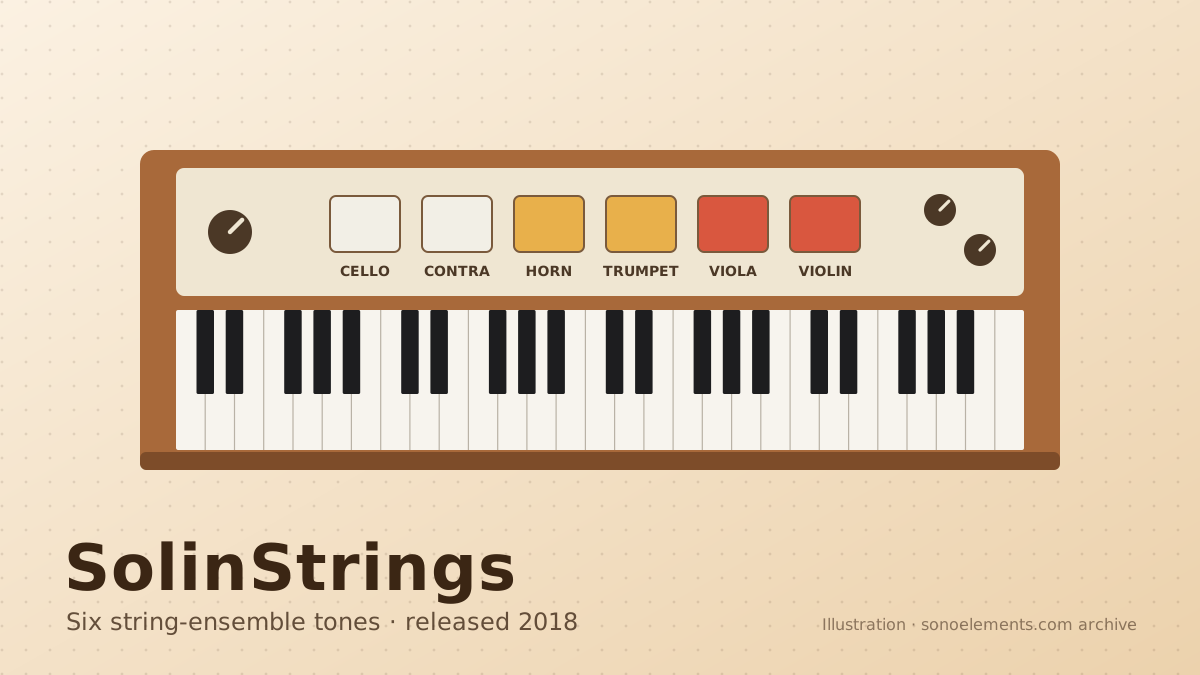
Sono Elements sampled the Solina’s six tone buttons: cello, contra-bass, horn, trumpet, viola and violin. The plugin then added something the hardware could not do: each tone has its own level and its own position in the stereo field. As on the original keyboard, the cello and contra-bass only sound in the lower octaves.
The manual suggested running the plugin through a phaser or chorus for a more authentic 1970s sound, since much of the instrument’s character on old records came from those effects.
Hear for yourself
SolinStrings audio demo
The original page explained that the demo pairs SolinStrings with an acoustic piano, with no other effects.
The recording belongs to the developer and is hosted by SoundCloud. Nothing is loaded from soundcloud.com until you click; after that, SoundCloud may set its own cookies (see the privacy policy). Open it on SoundCloud.User Interface
SolinStrings had the most controls of the catalogue, arranged in three rows. The diagram follows the row-by-row description in the developer’s manual.
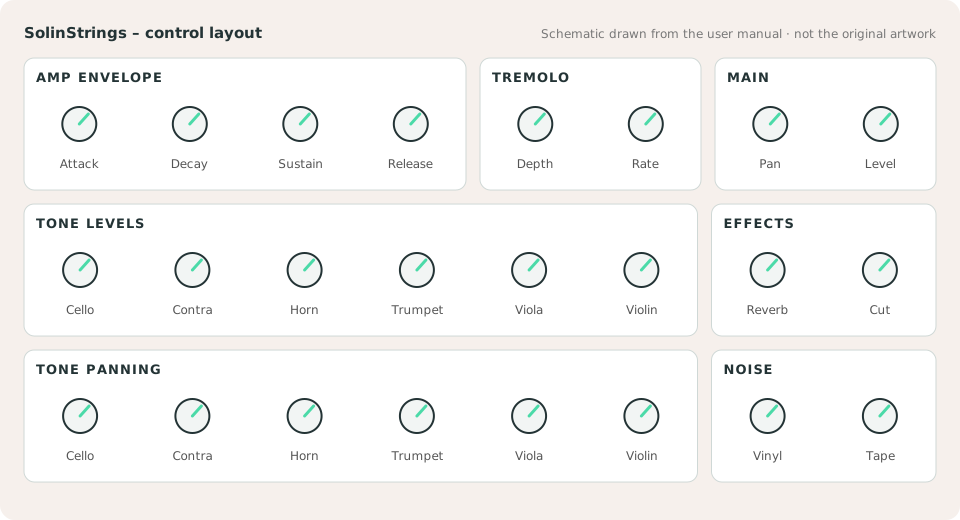
- Top row: one envelope and one stereo tremolo shape everything, including the noise layers. The main pan sets the final position of the whole instrument and overrides the individual tone pans.
- Middle row: a level for each of the six tones, plus reverb and a low-pass cutoff that act on the whole mix.
- Bottom row: a pan control for each tone, and vinyl and tape-hiss noise layers. The manual notes that tape hiss, combined with the filter and tremolo, can be used as a soft texture in its own right.
Features
- The six original Solina tones: cello, contra-bass, horn, trumpet, viola and violin
- Separate level and pan for every tone
- Amplitude ADSR envelope
- Stereo tremolo, low-pass filter and reverb
- Adjustable vinyl crackle and tape hiss
- Main parameters controllable by MIDI CC (list in the FAQ)
- VST and AU instrument for Windows and macOS
Sounds
- Cello
- Contra-bass
- Horn
- Trumpet
- Viola
- Violin
Cello and contra-bass play only in the lower octaves, as on the hardware.
System requirements
- Windows 7 or 10, or macOS High Sierra or later (the product page also listed Windows 8)
- At least 100 MB of free disk space
- At least 1 GB of RAM
- A VST or AU host (DAW)
- Intel Core i5 at 1 GHz or better
Manual
SolinStrings User Manual (PDF, about 1.3 MB)
Uploaded by the developer to the Internet Archive on 18 August 2018, the day of release, and still available.
Purchase
At launch SolinStrings cost US$19 and was sold through a Gumroad store page linked from the original article. That store page no longer exists: the link returned “not found” when this archive checked it on 2 November 2026. As far as this archive can tell, the plugin is no longer on sale anywhere.
This site does not sell SolinStrings. It cannot issue licences, resend downloads, process refunds or look up past orders, because it is not run by the developer. See the FAQ for what we do and do not know.
By 2020 the product page also carried a short warning that SolinStrings did not work on macOS Catalina (10.15) and that an update was on the way. The warning is missing from captures in December 2019 and present from September 2020. This archive has not been able to confirm whether that update was ever released, and it has no information about later macOS versions or Apple silicon Macs.
Sources
- Archived SolinStrings page, 9 Nov 2020 (Wayback Machine)
- SolinStrings user manual, uploaded by the developer (Internet Archive)
- KVR Audio: Sono Elements releases SolinStrings (Aug 2018)
- Rekkerd.org: Sono Elements releases SolinStrings
- Synth Anatomy: SolinStrings, a sample-based ARP Solina plugin (Aug 2018)
Original page: Wayback Machine capture of 9 November 2020. Last legitimate capture of this URL. Release date source: Atom feed of the original blog (captured 3 Dec 2018). This page was written on 2 November 2026 in new words; facts were checked against the sources above.